
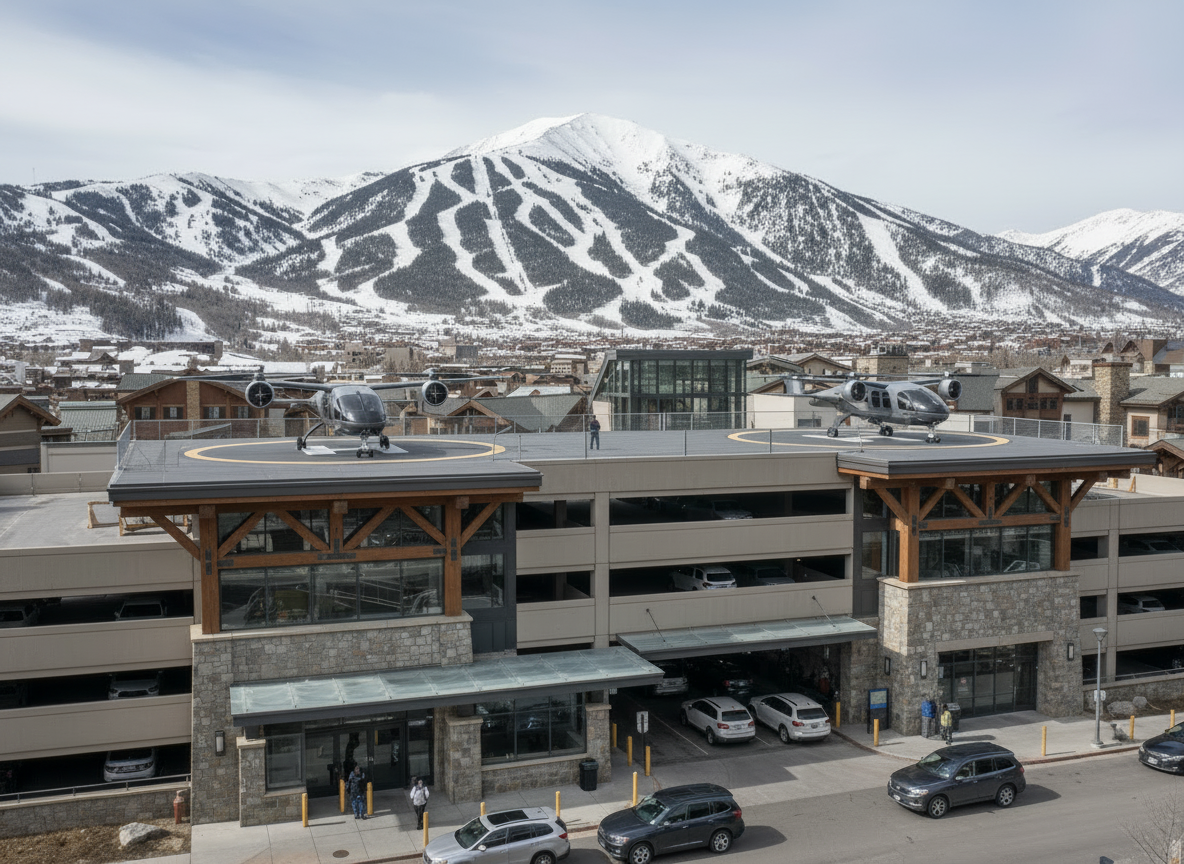
Air taxis are drawing serious attention from resort communities. Here is what the evidence actually shows about their near-term viability in Eagle County.
What eVTOL Technology Is — and Where It Stands Today
Electric vertical takeoff and landing aircraft — commonly called eVTOLs — are fixed-wing or multirotor aircraft that use electric motors to lift off and land without a conventional runway. Unlike helicopters, most eVTOL designs rely on distributed electric propulsion: multiple smaller rotors powered by battery packs or hybrid systems, reducing mechanical complexity and, in theory, noise and operating costs.
The sector attracted roughly $6.8 billion in disclosed investment between 2019 and 2023, according to data compiled by aviation consultancy Roland Berger. Major manufacturers include Joby Aviation, Archer Aviation, Lilium (which entered insolvency in late 2023 before restructuring), Wisk Aero, and Volocopter, among dozens of smaller developers. Several have announced partnerships with major airlines: United Airlines has pre-ordered aircraft from Archer; American Airlines has a conditional agreement with Vertical Aerospace.
Despite the investment activity, no eVTOL manufacturer had received full FAA type certification as of mid-2025. Joby Aviation and Archer Aviation were the furthest along in the U.S. certification process, each having completed early FAA conformity inspections, but neither had received an airworthiness certificate authorizing commercial passenger service. The FAA has described its eVTOL certification pathway as a novel regulatory challenge requiring new standards for powered-lift aircraft — a category that did not previously exist in U.S. aviation law.
Eagle County Regional Airport’s Role in Colorado’s Air Mobility Discussions
Eagle County Regional Airport (EGE) serves as the primary commercial air gateway to Vail and the surrounding resort communities. Located approximately 35 miles west of Vail Village at an elevation of 6,535 feet above sea level, EGE currently handles seasonal commercial service from major U.S. hubs and limited charter operations.
Eagle County has acknowledged interest in advanced air mobility as part of broader regional transportation planning. Airport leadership has participated in Colorado’s statewide aviation planning discussions, which include exploratory conversations about vertiport infrastructure. However, as of the time of this writing, no vertiport construction contracts had been awarded at EGE, no eVTOL operator had filed a commercial service application for Eagle County routes, and no county funding had been formally committed to eVTOL-specific infrastructure.
The airport’s high-altitude location is relevant to eVTOL performance calculations. Most publicly available eVTOL range and payload specifications are given at sea level or low-altitude standard conditions. Thin air at elevation reduces rotor efficiency and battery range, a factor that manufacturers and researchers acknowledge but that remains incompletely addressed in public technical disclosures.
Go Vail 2045: What the Long-Range Transportation Plan Actually Says
Go Vail 2045 is the Town of Vail’s long-range transportation master plan, adopted to guide mobility decisions through the middle of the century. The plan addresses traffic congestion, parking, transit, pedestrian infrastructure, and emerging transportation technologies. It is a planning document, not a capital commitment, and its horizon extends to 2045 precisely because many of its components depend on technologies and funding sources that do not yet exist in final form.
Advanced air mobility appears in Go Vail 2045 as a technology to monitor rather than a project to fund. The plan identifies eVTOL as a potential future tool for reducing ground-level congestion on I-70 and connecting resort guests from EGE to Vail without adding vehicle trips. It does not set a specific implementation date, identify a preferred operator, specify a vertiport location with binding site control, or allocate capital budget to eVTOL infrastructure. Planners placed it in the long-range, aspirational category — appropriate given the regulatory and commercial uncertainty that characterized the sector when the plan was developed.
Readers and property buyers who encounter references to “eVTOL service to Vail” in promotional materials should understand that Go Vail 2045 does not constitute a commitment to that service. It represents a planning aspiration subject to regulatory, financial, and technological conditions that remain unresolved.
FAA Certification and the Regulatory Timeline Buyers Should Understand
The FAA’s certification process for powered-lift aircraft — the regulatory category that covers most eVTOL designs — is proceeding under Special Federal Aviation Regulation (SFAR) 103, issued in October 2023. SFAR 103 established pilot certification requirements for powered-lift aircraft but explicitly noted that airworthiness standards for the aircraft themselves are still being finalized through separate rulemaking.
FAA administrator Mike Whitaker stated publicly in 2023 and 2024 that the agency intended to support eVTOL commercialization but would not compromise safety standards to accelerate manufacturer timelines. The FAA’s reauthorization act, signed in 2024, directed the agency to develop a comprehensive plan for integrating advanced air mobility into the national airspace — but set no statutory deadline for type certificates.
Industry analysts have offered a range of estimates for when the first commercial eVTOL services might operate in the United States. Conservative projections from consultancies including McKinsey and KPMG placed limited commercial operations in selected U.S. markets no earlier than 2026–2028, with broader regional network expansion pushed to the 2030s. Mountain and high-altitude markets — which present greater engineering complexity — are generally not included in near-term commercial launch projections from any major manufacturer.
Practical Constraints That Apply Specifically to a Vail-Area Operation
Beyond the national regulatory timeline, several constraints apply with particular force to any eVTOL operation serving Vail:
- Altitude and battery performance. Eagle County’s elevation imposes real aerodynamic penalties on electric rotorcraft. Battery energy density has improved steadily but remains lower than the energy density of jet fuel per unit weight. High-altitude hover requires more power than low-altitude operations, reducing effective range and payload. No major eVTOL manufacturer has published high-altitude performance data specific to Colorado mountain conditions.
- Mountain weather. The Gore Valley experiences significant orographic weather — rapid thunderstorm development in summer, low-visibility snow events in winter, and variable wind conditions year-round. eVTOL operations would require weather minimums at least as stringent as current helicopter operations, limiting the percentage of days on which scheduled service would be reliable.
- Vertiport siting. A functional eVTOL connection between EGE and Vail Village would require vertiport infrastructure at both ends: a landing pad, passenger waiting area, charging or fueling systems, and airspace coordination. No site in Vail Village has been publicly designated for this purpose, and the town’s density makes siting a non-trivial planning challenge.
- Economics of low-volume routes. The EGE-to-Vail corridor is short — roughly 35 miles — and serves a relatively small peak-season passenger volume compared to major metropolitan markets where eVTOL economics are projected to be most favorable. Operators targeting early commercial viability have publicly prioritized dense urban corridors such as Los Angeles, New York, and Miami.
- Noise and community acceptance. While eVTOL aircraft are generally quieter than conventional helicopters, they are not silent. Distributed rotor systems produce a distinctive high-frequency sound signature. How Vail residents and environmental regulators respond to regular low-altitude flight operations over the valley is an open question that no planning document has resolved.
A Cautious Planning Recommendation for Buyers and Property Owners
eVTOL technology is real, the investment is substantial, and the long-term potential for mountain resort communities is worth monitoring. But the gap between current regulatory status and commercially available service in Eagle County is wide — and the timeline for closing that gap is genuinely uncertain.
Property buyers evaluating Vail real estate should treat eVTOL access as a speculative future amenity, not a near-term transportation asset. If a listing or marketing material represents air taxi service as imminent or confirmed, ask for documentation: a signed operator agreement, an FAA-approved vertiport site plan, and a funded capital budget. In the absence of those documents, the representation is aspirational, not factual.
For property owners and long-term investors, the more productive question may be whether Vail’s existing ground transportation — I-70, the Eagle County Regional Airport commercial service, and the town’s transit system — continues to improve. Those are the systems that govern daily access today and will do so for the foreseeable future.
This publication will continue to report on eVTOL developments as the FAA certification process advances and as any operator files concrete plans for Eagle County service. Until then, the honest assessment is: watch this space, but do not price it into a purchase decision.
Editor’s Note: This article reflects publicly available information as of mid-2025. FAA certification status, manufacturer funding conditions, and local planning documents change frequently. Readers are encouraged to consult primary sources directly before relying on any specific data point. This publication has no financial relationship with any eVTOL manufacturer or air mobility operator.
Sources
- Federal Aviation Administration. Special Federal Aviation Regulation No. 103 — Powered-Lift: Pilot Certification and Operations. October 2023.
- Federal Aviation Administration. Advanced Air Mobility Implementation Plan. Pursuant to FAA Reauthorization Act of 2024.
- Town of Vail. Go Vail 2045: Vail Transportation Master Plan. Town of Vail Community Development Department.
- Roland Berger. Advanced Air Mobility: Market Study. 2023 edition.
- McKinsey & Company. Air taxis: Will the urban sky be the limit? McKinsey Center for Future Mobility, 2023.
- KPMG. Advanced Air Mobility: Navigating the Path to Commercialization. 2023.
- Joby Aviation. SEC filings and press releases, 2023–2025. Available at sec.gov.
- Archer Aviation. SEC filings and press releases, 2023–2025. Available at sec.gov.
- Eagle County, Colorado. Eagle County Regional Airport (EGE): Airport Master Plan and Operations Data. eaglecounty.us.
Leave a Reply