
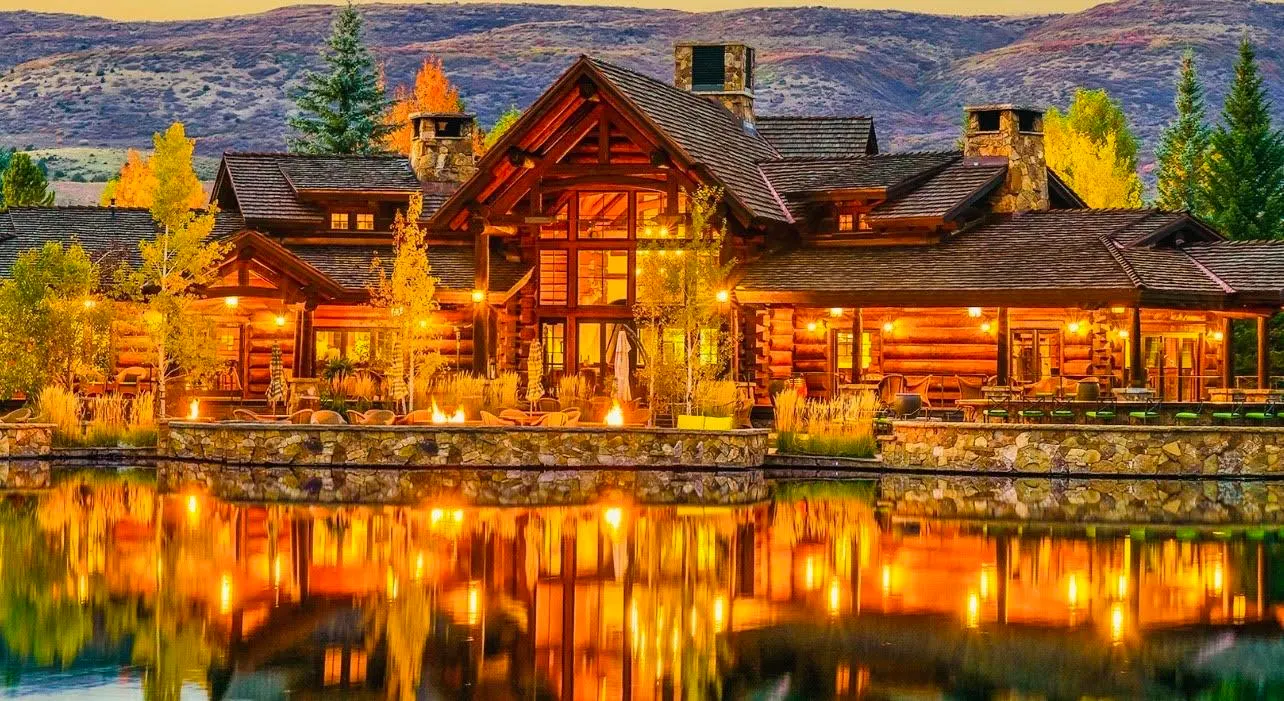
Now with nearly 24,000 acres under his ownership, Chuck Kuhn has doubled down on his Colorado ranch holdings; not to mention the previous owners knew what they were buying and selling
When golf legend Greg Norman listed his Seven Lakes Ranch near Meeker, Colorado in 2020 for $40 million, few could have predicted it would become a catalyst for one of the most significant land consolidations in recent Colorado history. In June 2021, the nearly 12,000-acre property in Rio Blanco County changed hands—and with it, the trajectory of high-end ranch ownership in the American West shifted noticeably.
Norman’s legacy in Colorado golf runs deep. In 2003, he designed the Norman Course at Red Sky Ranch & Golf Club in the Vail Valley, which opened June 30, 2003 as Colorado’s first Greg Norman-designed course. Red Sky features two world-class courses: the Norman Course and a Tom Fazio-designed course. The Norman Course winds through high-altitude meadows and aspen groves at elevation, and quickly established itself as one of the premier golf experiences in the Rocky Mountain region. Norman’s involvement at Red Sky signaled a deep personal affinity for Colorado long before Seven Lakes ever came to market.
Seven Lakes Ranch itself comprises approximately 11,900 acres in Rio Blanco County near Meeker, deep in the White River country of northwestern Colorado. The property features seven natural mountain lakes, the White River running through it, a lodge and full ranch infrastructure, and access to some of the most pristine elk and mule deer habitat in the West. Norman had owned the ranch for years, using it as a private retreat befitting his stature as one of golf’s all-time legends.
In June 2021, Norman sold Seven Lakes Ranch to Chuck Kuhn’s JK Land Holdings (JKLH) for $40 million. Hall and Hall served as the listing broker; Hayden Outdoors brought the buyer. The transaction closed June 1–2, 2021 and was covered nationally by Architectural Digest, Golf Digest, and the Washington Business Journal. For Kuhn, it was not merely a real estate transaction—it was the anchor acquisition that set his Colorado land strategy in motion.
Kuhn’s stated intention for Seven Lakes was conservation-focused stewardship—preserving the land’s ecological integrity, its wildlife corridors, and its ranching heritage. This aligned with the broader conservation easement strategy Kuhn has employed across his Virginia land holdings, suggesting a consistent philosophy: acquire significant land, preserve it, and build long-term legacy value rather than develop it.
The Seven Lakes Ranch Acquisition
Seven Lakes Ranch is not merely another high-end Colorado property. The 12,000± deeded acres that Kuhn acquired represent one of the most coveted fly fishing ranches in the state—a combination of private water rights on the White River, seven lakes and diverse terrain spanning from river meadows to high-elevation aspen groves fostering some of the larger herds of elk and record mule deer with direct access to public lands that have drawn serious outdoor enthusiasts for decades.
What makes Kuhn’s stewardship particularly notable is how he restructured the property almost immediately. Rather than hold it monolithically, he retained the 14,000 square foot Seven Lakes Lodge and approximately 220 acres for operational and hospitality purposes. The bulk of the acreage was then strategically transferred to the adjacent Elk Creek Ranch. Concurrently, Kuhn placed conservation easements on the property—a decision that aligns with both tax strategy and his publicly stated philosophy of balancing productive use with long-term environmental stewardship.
The acquisition drew national attention from outlets including WTOP, Forbes, The Land Report, and the Western Landowners Alliance—signaling that major land deals in Colorado are now tracked with the same intensity as commercial real estate plays in coastal markets.
Chuck Kuhn Acquires the Famed Elk Creek Ranch from Rob Walton
Elk Creek Ranch, situated in Rio Blanco County near Meeker in northwestern Colorado, stands among the most storied private sporting and conservation communities in the American West. Long recognized for its world-class elk and mule deer hunting, exceptional fly fishing on the White River, and a community model that blends private ownership with shared conservation values, the ranch represents a rare convergence of ecological significance and recreational prestige. In August 2026, that legacy changed hands when affiliates of Chuck Kuhn and JK Land Holdings acquired approximately 14,400 deeded acres from entity affiliates tied to Rob Walton — the eldest son of Walmart founder Sam Walton — for a total consideration of $38 million.
The transaction did not unfold in isolation. It was in fact the culmination of a deliberate land assembly strategy Kuhn had been executing since June 2021, when he purchased the adjacent Seven Lakes Ranch from golf legend Greg Norman for $40 million. Rather than hold Seven Lakes as a standalone estate, Kuhn retained the 14,000-square-foot Seven Lakes Lodge and approximately 220 surrounding acres for operational and hospitality purposes, then conveyed the remaining roughly 12,000 acres directly into Elk Creek Ranch. That strategic transfer dramatically expanded the ranch’s footprint, and together with the 2026 acquisition from Walton’s affiliates, it has helped position Elk Creek Ranch as one of the largest private sporting communities in the West.
Conservation has been central to Kuhn’s vision for the property from the outset. In keeping with both his publicly stated philosophy and his broader land strategy — which has included the placement of conservation easements across multiple Virginia holdings — Kuhn has pursued easements on the Elk Creek acreage as well. These instruments serve a dual purpose: they provide meaningful tax efficiency while simultaneously enshrining the land’s ecological integrity in perpetuity. For a ranch defined by its wildlife corridors, its native trout fishery, and the sheer scale of its high-country terrain, the conservation easement structure is not incidental — it is foundational.
With the Elk Creek acquisition now closed, Kuhn controls in the neighborhood of 24,000 acres in Rio Blanco County — a portfolio assembled over the span of five years through two of the most consequential ranch transactions Colorado has seen in recent memory. The previous owners on both sides of that ledger, Greg Norman and Rob Walton, were themselves celebrated stewards of exceptional land. That each chose Kuhn and JK Land Holdings as the successor speaks to the credibility he has established not only as a buyer of scale, but as a custodian of the West’s most irreplaceable landscapes.
Who Is Chuck Kuhn?
Chuck Kuhn is not a traditional real estate developer in the mold of the East Coast second-home market. Rather, he is an operator and an acquirer—someone who built a major business from the ground up and then applied that same discipline to land assembly.
As founder and CEO of JK Moving Services, based in Northern Virginia, Kuhn built one of the largest independent moving companies in the U.S. He is not a passive investor; he is a builder and operator. That operational mindset has defined how he approaches land acquisition through JK Land Holdings, his investment and assembly arm.
His prominence in the business world received formal recognition in early 2025, when he was named to the Washington Business Journal Power 100 list. More recently, in February 2026, Kuhn was profiled by Commercial Observer, which highlighted his stated philosophy: seeking “balance” between development and conservation. That balance framework is central to understanding both his land strategy and his public positioning.
The Virginia Land Assembly: Context for Scale
Before Kuhn’s Colorado acquisitions, he had already assembled one of the largest private land portfolios on the East Coast through JK Land Holdings’ activities in Northern Virginia. Understanding the scope of those Virginia deals provides essential context for evaluating his Colorado strategy.
In August 2024, JK Land Holdings acquired a 25-acre parcel in Loudoun County for $60 million—a transaction that underscores the scale at which Kuhn operates. Far more significant was the November 2025 sale of Leesburg land to a data center developer for $615 million. This was not a single-property transaction; it represented the culmination of years of strategic land assemblage. Similarly, a $141 million assemblage of Manassas sites targeted data center development, reflecting Kuhn’s sophistication in identifying market trends and structuring large-scale deals around emerging demand.
These Virginia deals—totaling hundreds of millions in value—signal that when Kuhn decides to acquire property, the transactions are typically large, strategic, and often part of a broader assemblage thesis. They also indicate his willingness to place conservation easements on holdings, as he has done in Virginia and Colorado, blending tax-efficient structuring with genuine conservation commitment.
Notably, in July 2026, Washington Business Journal reported that Kuhn leased part of a Middleburg, Virginia farm to Vice President JD Vance and his family—another indicator of his footprint as a major Northern Virginia landowner and the trust placed in his stewardship.
What This Signals for the Colorado Ranch Market
Kuhn’s acquisition of Seven Lakes Ranch, taken alongside his broader land assembly activities in Virginia, points to a maturation in how ultra-high-net-worth individuals approach Western land ownership. The old model—acquiring a trophy property for personal use and enjoyment—has been supplemented (though not replaced) by a newer model: strategic accumulation, conservation easement placement, and operational integration with neighboring properties.
For the Colorado ranch market, particularly in the ultra-luxury segment represented by properties like Seven Lakes, this signals that buyers are increasingly sophisticated operators rather than trophy hunters. They view land as a long-term store of value, a platform for conservation, and an asset class that rewards patience and scale. The willingness to immediately restructure Seven Lakes—transferring acreage to Elk Creek Ranch rather than holding it as a monolithic estate—demonstrates that modern landownership prioritizes flexibility, operational synergy, and strategic positioning over the prestige of holding the largest single-owner property.
For those tracking the high-end Colorado real estate market, Chuck Kuhn’s emergence as a significant buyer—and more importantly, as a sophisticated operator managing lands across multiple states with deliberate conservation and financial strategy—represents a meaningful shift in who commands and shapes the market for Colorado’s most valuable land assets.
Leave a Reply