
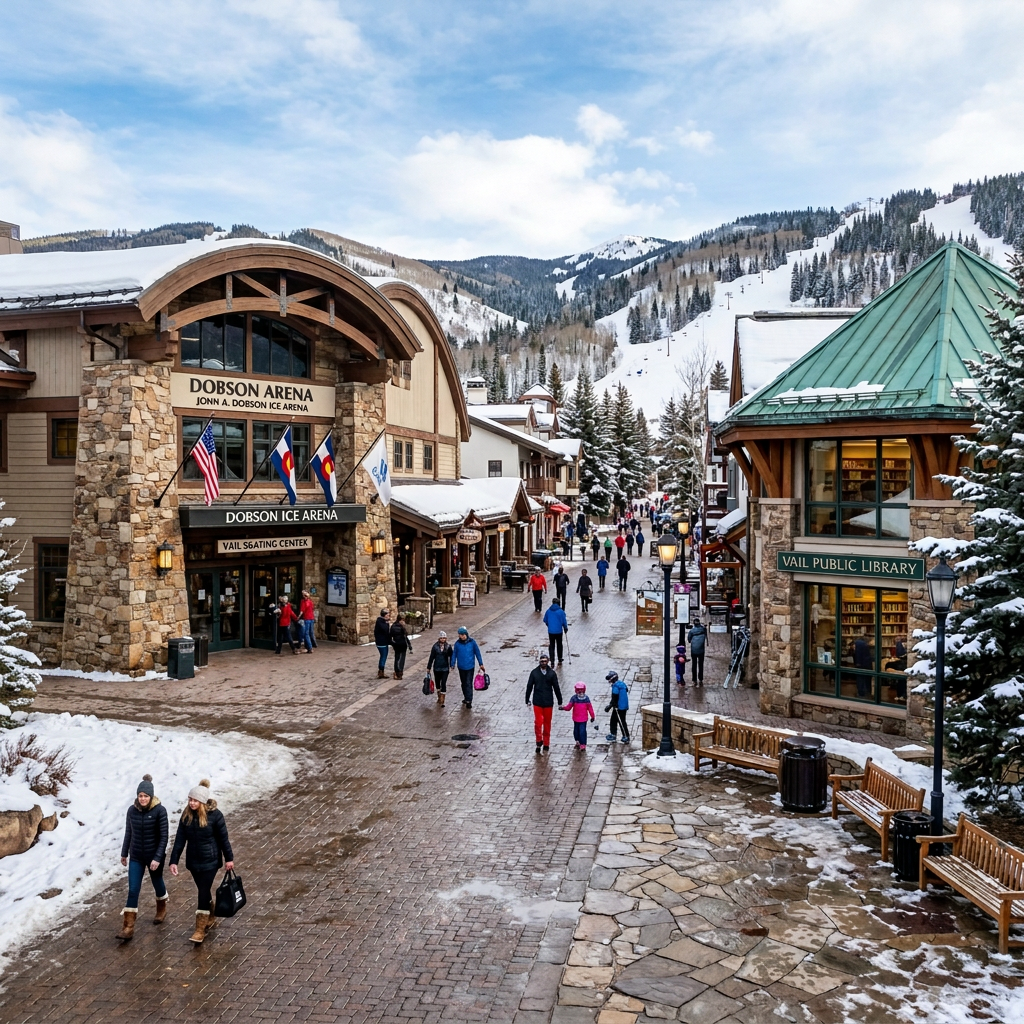
A thermal-energy system linking Dobson Arena and the Vail Public Library could capture waste heat, reduce snowmelt emissions and become the first node of a larger Lionshead and Vail Village geothermal energy district
While the remodel and transformation of Dobson Arena is taking place above ground; another ambitious Town of Vail project is beginning mostly out of view beneath the ground and behind the mechanical rooms of the buildings it will eventually serve. This geothermal energy project will eventually make and maintain the ice at Dobson Arena while providing heat to the Vail Public library.
A thermal energy system uses heat pumps & exchangers circulate water through piping between buildings, exchanging thermal energy to provide heating and cooling. In winter, piped in hot water heats buildings and cooled water returns to the system; vice-versa in summer.
Dobson Arena must remove heat to make and maintain ice. Nearby, the Vail Public Library, municipal buildings and outdoor snowmelt systems require heat. Instead of allowing the arena’s rejected heat to disappear into the outside air, Vail is developing a shared thermal-energy network capable of moving, storing and reusing that energy.
The Geothermal Heating and Ice Making system will consist of a closed network of water-filled pipes, heat exchangers, heat pumps and geothermal boreholes that can transfer thermal energy between the two connected buildings. According to the U.S. Department of Energy’s explanation of networked geothermal systems, these thermal energy networks can serve several buildings at once and draw from multiple sources so as to always maintain heat where you need it and cold where you don’t.
Heat pumps do the concentrating. Like a refrigerator working in either direction, they move heat from where it is not wanted to where it is useful. If this sounds like a new concept, it;’s not. This process has been well researched and has been used for years in European countries.
The first funded node centers on the Vail Public Library and neighboring Dobson Arena. It is part of the broader Vail Energy Conservation and District Geothermal Project approved by the Vail Town Council in November 2025.
The Town of Vail’s 2025 Annual Report describes a $9.1 million package that combines the geothermal work with municipal HVAC and lighting upgrades, solar energy, battery storage, electric-vehicle charging and other efficiency measures. The Town reports that more than $4.2 million of the cost is offset through grants, project partners and Inflation Reduction Act funding.
| Project Measure | Town of Vail Estimate or Status |
|---|---|
| Broader energy project cost | Approximately $9.1 million |
| Outside funding and incentives | More than $4.2 million |
| Expected annual energy savings | More than $200,000 |
| Simple payback | Under 14 years |
| Colorado geothermal award | $1,781,506.80 for the library–Dobson thermal network |
| Initial geothermal node | Vail Public Library and Dobson Arena |
| Larger Lionshead network | Technical and economic feasibility work continues |
These figures apply to the combined energy-conservation program, not geothermal alone. The Town estimates that the overall package could accomplish nearly 30% of the progress required to reach its goal of reducing municipal emissions 50% by 2030.
Making ice does not create cold so much as remove heat. Dobson’s refrigeration equipment draws heat away from the rink surface and must distribute that heat somewhere else. In a conventional system, much of it is discharged outdoors. In a thermal network, it becomes the heat source. So, the library can use this recovered energy for space heating and nearby snowmelt systems. Geothermal boreholes will help balance the network by absorbing heat when supply exceeds immediate demand.
The Town of Vail began testing the concept in late 2023 by drilling an approximately 500-foot borehole in Ford Park and evaluating the ground’s thermal conductivity. That work helped engineers estimate how many boreholes might be required, how they should be spaced and how effectively the subsurface could store and release heat.
By April 2025, the Town had received a $250,000 Colorado Energy Office grant for geothermal-district design and had budgeted an additional $150,000. The Town Council then approved a development contract with McKinstry to advance the technical, economic and organizational planning.
In October 2025, Colorado awarded Vail a separate $1,781,506.80 refundable geothermal tax credit for installation of a network connecting the library and arena. The state award announcement also identified possible future connections to Bridge Street, the ski area, lodging properties and sanitation facilities. In February 2026, the Town Council unanimously approved the intergovernmental agreement needed to accept the award.
The larger Vail and Lionshead geothermal energy districts are still being evaluated for technical feasibility, economics, ownership, operation and future participants.
At the July 7, 2026 Town Council meeting, staff and McKinstry presented an update on the larger Lionshead and Vail Village feasibility study. The Town described that work as an expansion beyond the geothermal projects underway at the library, and Council requested more frequent progress reports as planning continues.
McKinstry is working on energy-performance planning and the potential business, governance and ownership structure. The Grey Edge Group has provided specialized engineering work for the envisioned thermal network. Expansion to private lodging, Vail Mountain or sanitation infrastructure should therefore be understood as a future possibility—not a completed commitment.
Project status and financial figures are based on Town of Vail, Colorado Energy Office and project-team information available through Aug. 14, 2026. The larger Lionshead thermal energy district remains under feasibility review, and future participants, costs and schedules have not been finalized.
Leave a Reply